Friday, March 3, 2017

The Reluctant Roadbike Commuter


When I moved to rural Ireland, lots of people said (or wrote) to me some equivalent of: Aha! There’s no way you will continue commuting on an upright step-through bike. Those distances, those hills, those wind speeds? A roadbike will be more efficient and faster.

And they weren’t wrong about those factors posing a challenge for plain-clothed transport cycling, as I had hitherto known it. However, I resisted the switch. Not out of principle. But because for transport, I genuinely feel more comfortable, more relaxed, more at ease, on an upright step-through bicycle - pedaling at moderate speeds, wearing my street clothes and shoes, arriving at my destination refreshed but not bedraggled.

And so, despite the challenges of my new environment, I never changed my ways. And three and a half years later I still mostly commute on upright step-throughs. There are, however, times when even I must concede this is not a suitable option. When my destination, for instance, lies over a mountain and time is of the essence. Or the wind is so strong, that an upright bike would mean traveling at walking speed. Or even when I want to get some exercise and do not have the time to cycle for transport and sport as separate activities.

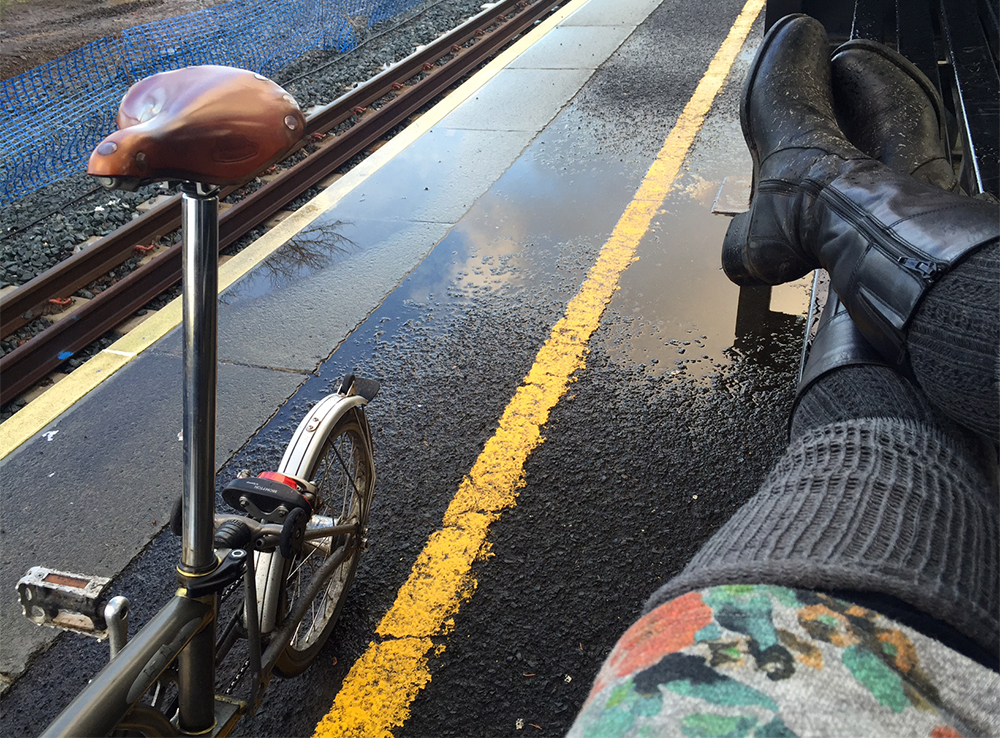
On those occasions, I do use a roadbike to get around. And while it's not exactly ideal, I try to make the best of it. And as I rarely discuss this particular topic, today I thought I'd share my setup with you here.

Monday, December 12, 2016

Would You Rather?


It's a game I inadvertently ended up playing over the weekend, and I now pass it on to you. In short:

Would you rather?

A. ride short distances for work and errands every day, but give up roadcycling completely, or

B. put in all the road miles you want, but give up utility cycling altogether?

Saturday, November 12, 2016

I Am a Slow Moving Vehicle


I got chatting to a fellow the other day who commutes to work by bike. He has been cycling for a couple of years now, having bought a racing bike as part of the cycle to work scheme.

Eying up the bike I was on, he said, "Right enough, all that would be handy!" - gesturing sweepingly at the mudguards and racks and bags and upright handlebars.

"Why didn't you get one like it?" I ask.

"Ach, where I live it would be too slow. Drivers would go mad sitting behind me!"

Friday, February 19, 2016

Auto Neurotic

"Second gear, now?

"No. Far too early."

"Now?!"

"No! Wait till you approach the markings... Okay, now! Brake. Clutch. Second gear. Look right. Is it clear? Keep going."

As we proceeded through the roundabout on our bicycles, mine possessing no gears what so ever, the humour of the situation was not lost on me.

Saturday, January 16, 2016

Winter Training

"It's normally much better behaved than this!" I heard myself say to the train conductor, in a frazzled, parental voice, as my bicycle buckled and slid away from the space I'd been trying to shove it into with one hand, whilst paying the faire with the other.

"No worries," he said, looking in fact slightly worried for me.

"Sometimes they'll not do as they're told," added a man behind me, as if in my defense.

"Happens to the best of them," chimed in another at the other end of the car helpfully.

A parcel-laden woman in a yellow beret chuckled.

Tuesday, December 22, 2015

Award-Winning Fredliness

Fred Awards Belfast 2015
Having been inundated with internet "cycling culture" for years, I sometimes take it for granted that those who ride bikes will know all its geeky jargon. But when I told my own Beloved Cyclist about the Fred Awards, he surprised me by not getting the reference. Who is this Fred, and why is he being awarded? Chuckles aside, his genuine not knowing made me pretty happy - as it means the ludicrous concept of "fredliness" is not as malignantly pervasive as some of us might imagine, having spared at least some cyclists who roam the quiet country lanes of Ulster. Clearly, however, it has not spared the more cosmopolitan people of Belfast - who are not only aware of the term, but have organised a club around it!

Friday, December 4, 2015

Plan B for Bicycles

Some time ago I met a woman who cycles for leisure daily, but drives a similar distance to work. I asked her why not ride her bike to the office? "Oh, I'd love to!" she said. "But I can't do my own repairs you see. If I break down, I'll never get to work on time!"

It's a concern I've heard before many times. And it is one that, on the face of it, sounds so reasonable as to almost be self-evident. But beneath the veneer of logic it is actually a non-issue. And here is why.

Monday, August 10, 2015

Car vs Bicycle Speed: Rural Edition

Untitled
One of the trickiest parts to driving a car in rural Ireland, is navigating the narrow winding roads. Even the "main road" where I live is a single carriageway, barely wide enough for two standard-sized cars to pass each other in opposite directions, with constant hairpin bends and blind crests. At the side of the road there is no "shoulder," but instead ravine-like trenches. Let your wheel wander too near to the edge, and your car will be violently pulled off the road. Misjudge the distance in the other direction, and you'll smash into oncoming traffic. As a driver, you cannot ever let your guard down. And you must constantly monitor and reduce your speed.

Tuesday, May 5, 2015

Voyages Multimodaux

Bellarena Train Station
The train was moving quickly, the blues and greens and yellows of the landscape blurring and running into one another in the glare of the morning sun. The diminishing mountain in the distance resembled now a flat brown cutout, sitting dull and static beyond the shimmer of the jagged marshy shore. In the corner fold-down seat I was fenced in by my bicycle resting against me on a diagonal. This created a sense of being in a tiny private compartment - just me, the bike, and the window with its views of endless grass and water. My fingers began to tap on the handlebars to the train's rhythm, as the lyrics to that exuberant '80s gem Voyage-Voyage popped into my head. All things considered, it was not a bad start to a long day.

Monday, March 23, 2015

On Financial Incentives for Cycling and the Psychology of Compliance

This morning I came across a recent Atlantic CityLab article called The Problem With Paying People to Bike to Work. It interested me immediately, as just a few days earlier a friend and I were debating the effectiveness of UK's cycle to work scheme (which offers discounts and tax breaks when buying a bicycle for commuting). The CityLab piece, however, focuses on something a bit more radical: France's pilot program that pays employees to commute to work by bicycle. In case you've never heard of this, it was a 6-months trial in the course of which bicycle commuters were compensated roughly 43 cents per mile when cycling to work. The project received much fanfare at the start, but the results have been less than stellar. The author of the CityLab article critiques the program and offers two explanations for its limited success: the continued availability of cheap and free parking, and the "fixed" nature of commuters' habits. As this latter explanation is based on psychological studies and I happen to be a (former) research psychologist by profession, I offer another perspective for consideration:

Thursday, February 5, 2015

Of Garden Paths and Urban Routes

bicycles in Belfast
As I sit and work beside a window overlooking my garden, I observe a small barn cat crossing the lawn toward a distant cluster of trees. Both this particular cat and a few of the others make this journey several times a day. And the fascinating thing about it is, they don’t hop across the grass. Neither do they slink through the shrubbery. Rather amazingly, they follow the garden path. The dedicated garden path - a gently curving narrow dirt tract - is not the quickest or the most direct route across the lawn. The cats are not required to use it; indeed no one would expect it of them. And yet they insist on walking along the path, in an elegantly unhurried sort of trot - as if drawn to this more civilised method of moving from A to B.

Friday, January 16, 2015

In Mixed Company

Bikes of Westport
Late one night I received an urgent "help!" text from a friend who had met a man she liked in a bar. The fellow, who'd arrived by car, invited her to Go Home with him. She had arrived by bicycle, and, while ever so keen to see his stamp collection, did not want to leave her bike locked up in a shady neighbourhood overnight. Not to mention she'd need it to travel to work in the morning. In an innuendo-filled, tween-worthy texting fury we debated whether her date's car was spacious enough to fit her hefty 3-speed. But ultimately, she decided that even broaching that subject would Kill the Mood - after all, she'd just met the man! So she opted to go home alone instead, feigning maidenly ambivalence toward his stamps. "Need folding bike to get laid, goddamn it!" was her sad parting text to me that night.

Thursday, June 5, 2014

Visceral Entertainment

When we glamourise urban transportation cycling, a favourite fantasy activity of this genre is cycling to the theater. A civilised evening out and you can do it on a bike! Oh my. Wistfully we picture elegant sophisticates pedaling stately steeds unhurriedly, their tranquil faces luminous in the neon glow of storefront signs. 

Meanwhile, there I was… bracing against the headwind, sweat streaming down my face, as I cycled 7 miles past endless fields stuffed with grazing sheep, the smell of freshly spread manure filling the evening air. Ah, rural cycling at its finest. A civilised evening out and you can do it on a bike! 

At last, and only slightly worse for wear, I arrived in the tiny town of Limavady to see the much-recommended Flesh and Blood Women. The community arts center where the play was staged has this multi-purpose room that makes for an intimate auditorium, with the audience clustered close to the stage. When I walked in, the place was packed. The only available seat that offered a decent view was in the front row. I took it. And, as the lights dimmed and the performance began, I found myself face to face with the actress delivering the first monologue. 

I have seen my share of plays, but it's been a while since I'd seen one in a venue this small, sitting this closely to the stage. I had almost forgotten that, when a play is good, the physical presence of the actors is so viscerally engaging as to be overwhelming. It is as if a real event unfolds in our presence. We don't just watch it happen; we feel it happen.  

The actress in front of me was so very there I could see her eyes tear up, her forehead glisten with sweat and her calf muscles twitch as she paced in stiletto heels. I could feel the force of her breath when she spoke. Her emotions vibrated and these vibrations in turn resonated through my own body. Weakened and relaxed by the physical effort of having cycled into town, I found myself especially receptive to this stage presence physicality. There was a rawness to watching the play that matched my own state of being.

Feeling all this, I could not help but recall the previous week, when a friend and I had driven to see a movie. These experiences were parallel, but so interestingly different. Seeing a movie on a screen versus seeing a play, and driving versus cycling. In one there is a degree of separation introduced that dampens the visceral and makes for a more detached, abstract experience. In many ways, this is a more comfortable way to be - to travel, to observe, to seek entertainment. There is privacy, protection. There is a reduction in effort. But in spite of this - or perhaps because of it - it cannot pack a punch as strong as direct experience. 

Riveted by the persons on stage in front of me, I hear the final click of their heels as they leave the stage and imagine pedaling home in the cool country night. What a strange and visceral entertainment. 

Friday, February 14, 2014

Give Me Shelter

Passing through a University of Ulster campus the other day, I saw a couple of these neat bicycle parking structures. A transparent plexiglass shelter has been put up around an ordinary 6-slot bike rack. Likely in tribute to the campus's seaside location, the enclosure is abstractly sail-shaped. There is an intriguing quality to the way it catches and reflects light even in overcast conditions, and I was not the only passer-by inspired to snap a photo. Others ducked beneath to hide from a sudden burst of rain. One student even actually used it to lock up his bike. He then lingered inside while making a phone call before reluctantly moving on.

Despite its resemblance to contemporary sculpture, the university's enclosed bike rack is basically a modified bus shelter, of the kind commonly scattered through the local countryside - light-catching properties included. These too will sometimes function as makeshift refuges for pedestrians and cyclists - locals who aren't waiting for a bus, but want some cover from rain or wind. It seems this kind of structure makes for a useful multi-purpose design.

My picture of the sheltered campus bike rack received some positive feedback from cyclists, which makes me wonder to what extent a feature like this is valued. For those who must leave their bikes outdoors for 8-hour work days, sheltered racks would offer some protection from the elements. On the other hand, they would not really do much to deter theft compared to ordinary bike racks. Still, they could be an option worth considering for employers who cannot provide indoor bicycle parking - particularly in areas where weather damage is a bigger concern than theft. It might also be nice if the sheltered bus stops could be combined with bike racks of the same design, which could, in turn, encourage multi-modal commuting - particularly in winter. With storms hitting both sides of the pond pretty hard at the moment, rain and snow are playing starring roles in our lives, but we pedal on when possible and take shelter where we can!

Wednesday, February 5, 2014

Transportation Cycling in Rural Areas: Some Food for Thought

The present-day culture of transportation cycling is predominantly associated with urban living. This makes sense, considering the realities of life in cities and their immediate vicinities. When commuting distances are short, motor vehicle traffic horrendous, and public transportation either overcrowded, unreliable or both, riding a bike can become an attractive option for getting around. Throw in some cycling infrastructure and perhaps a bike share system, as many cities are currently doing, and the appeal becomes greater still – especially as rising numbers of others take to the streets on two wheels, making it seem increasingly more normal and realistic.

But the desire to cycle for transportation is not limited to urbanophiles. Some rural residents may be commuting by bike already. Others may be considering it. Others still may be cyclists who currently live in a city, but are contemplating a move to the countryside. For the latter two groups a slew of questions and concerns might arise, with not a whole lot of resources out there to address them. This has become especially apparent to me since my own move to the countryside some months ago - in the course of which my email inbox has filled with questions from a surprising number of would-be rural bicycle commuters. Now that I’m feeling a bit more settled, I would like to start sharing some thoughts on the topic.

To state the obvious, there is a great deal of regional variation between rural areas. Differences in climate, terrain, distances and the availability of safe cycling routes will play a huge role in how realistic commuting by bike will be. Perhaps less obvious is that these differences can exist even within the same locale: pockets dense in amenities and pockets that are not, pockets that are hilly and pockets that are flat, pockets that offer safe routes for cycling and pockets that do not. As an example: My current house, while situated in what is generally a remote and shockingly hilly part of Northern Ireland, happens to be in a pocket that is unusually convenient and bicycle-friendly. I am just over a mile from a sort of farming hub, with several small shops selling basic provisions and local produce, and 7 bike-friendly miles from the nearest small town. Being at the base of a mountain but not on it, I have easy access to flat routes and enjoy mostly ice-free roads in winter due to warmer temperatures than neighbours who are even slightly uphill. In a pinch, I am also only a mile from a bus stop and two miles from a train station. Other parts of this very same region are far less handy for getting around by bike. This is all to say that it is essential to get to know an area thoroughly before forming an impression of what commuting by bike will be like there. Even to assume regional homogeneity would be a mistake. 

But speaking more generally, rural transportation cycling, as I see it, is not just about locations, distances and terrain. It is a categorically different kettle of fish from urban cycling. Why? Because it is fueled by a different set of motivations. Whereas in the city, cycling might be the faster, more convenient transportation option, in the countryside that is extremely unlikely to be the case. With long miles to cover, little in the way of traffic congestion and parking easy to come by, the car is clearly the more convenient choice here. So in devising ways to commute by bike in rural areas, we are doing so because we value cycling in of itself more than we value convenience. For some, this could boil down to physical fitness. Commuting by bike make take longer, but it is in fact two activities in one - commuting and keeping fit, saving time that would otherwise be spent at the gym. For others the real issue is financial. The bike costs next to nothing to run compared to the costs of a car, and for that some loss in convenience could be seen as worth it (or simply, necessary). There could be other underlying factors. Environmentalism. Or the inability, be it for legal or physical reasons, to operate a motor vehicle. But all that considered, I would venture to say - and this is just a guess really, a hunch, an intuition - that for a great portion of dedicated rural bicycle commuters in the developed world, the love of cycling for its own sake is the dominant motivating factor. It may be an irrational love. A love that goes against what's reasonable or practical. But it's a love strong enough to, however creatively, turn it into reality. Otherwise, it is just too easy to opt for other forms of transportation. And people generally do what's easy, unless they love the other option that much more. 

In the coming months, I hope to continue sharing thoughts and ideas on different aspects of rural transportation cycling. I would also like to compile a list of rural cycling blogs and post it here. My collection of links to those is pretty small so far, so if you know of any - or write one yourself - please do share!

Wednesday, January 22, 2014

The Mountain Bike for Commuting

Although most cyclists around these parts are roadies, I do occasionally see people cycling for transportation. More often than not they are riding mountain bikes. For some time now, mountain bikes have functioned as de facto commuter bikes in places without a culture of dedicated utility bicycles. And while they lack the trimmings of transportation-specific machines, mountain bikes do have some features that can work pretty well for commuting. I've been thinking about this since last Autumn, when, for a period of about a month I rode a friend's mountain bike in this capacity. Even now that I have my own Brompton here with me, I still use a mountain bike on occasion to get to specific destinations - appreciating its benefits as well as noticing its shortcomings for getting around. Here are some thoughts on both.

What makes the mountain bike immediately appealing to me as a hop on and go bicycle, is the combination of positioning and stepover height. The straight handlebars allow for a sportily upright posture. And most MTB frames today have sloping top tubes, some so dramatic as to out-slope a typical mixte frame. These features make the bike easy to ride casually in my street clothes - including skirts, dresses and long coats.

Then there is the usefulness and stability of the wide knobby tires, making poor road conditions a non-issue. They are great for cycling over potholes, mud, debris, sand, even winter slush and snow and occasional ice. The tires can also open up commuting options, making it possible to cut through forest trails and across fields. Finally, fat tires mean that regardless of frame material and other factors, the bike is unlikely to have a harsh ride quality (a suspension fork, if present, will further contribute to this).

The super-low gearing that comes standard on typical mountain bikes is a godsent for traveling through hilly areas. Even the steepest mountain roads can be tackled in comfort with a sub 1:1 gear.

The 26" wheels address my dislike of toe overlap, even with wide tires.

The disk brakes commonly found on most modern mountain bikes offer excellent braking power in all weather conditions.

Finally, mountain bike frames today are typically made of aluminum, which makes them resistant to rust in wet climates and salty road conditions.

All of these features may not make for the prettiest of bikes, but from the standpoint of sheer practicality they are attractive. And in addition, I find the sporty handling and playful feel of a decent mountain bike quite fun.

As far as drawbacks, the obvious ones are the missing fenders and racks. Cycling in the rain or after the rain quickly turns street clothes into a mess. And there is no convenient way to carry things on the bike. Of course both fenders and racks can usually be retrofitted. But this introduces extra costs, complexity, and compatibility issues. And on a borrowed bike doing so if not really feasible. All of this also applies to lighting, for those who prefer the convenience and security of dynamo lights.

Gripping the straight handlebars can also feel uncomfortable over longer distances, and while handlebars can be changed this again introduces extra work, cost, etc.

Otherwise, the one thing I am not crazy about is the high bottom bracket typical of mountain bike frames, preferring a low bottom bracket instead. This, however, is not a dealbreaker, just a personal preference.

All in all, I feel that a decent quality mountain bike, if properly accessorised, can make for a comfortable, practical, versatile and fun transportation/ utility bicycle. And while there do exist readily available bikes on the market (under the "hybrid" category) that appear to already accomplish this, in the past I've disliked the ones I've tried - consistently finding them uncomfortable and inefficient. Recently I tried a few once again, in an attempt to understand what it was about them I disliked. And the thing is, while some of these commuter-ready bikes may superficially resemble mountain bikes, with their fat knobby tires, suspension forks, and general aesthetic, the geometry and handling feel off. I am guessing the manufacturers alter traditional MTB designs to accomplish a more upright position and cruiser-like handling, in the process ending up with a bike that's really neither here nor there.

Despite the recent increase in dedicated transportation bicycles of all stripes, I think the mountain bike, with some modifications, remains a good off-the-shelf option, especially for those with hilly commutes and mixed terrain possibilities, who nonetheless want to dress in street clothes and sit upright. And why not? The more options the merrier.

Monday, November 18, 2013

A New Context

Misty Mountain
The transportation choices we make tend to be context specific. This goes for the "big" choices such as bike versus car versus train versus bus versus spaceship versus horse and carriage. It also goes for specifics such as what kind of car or what kind of bike we choose, as well as the ways in which we use them. 

It should come as no surprise that my own preferences and viewpoints have been largely shaped by cycling in and around Boston for the past four and a half years. At the beginning there were stretches of Vienna mixed in as well, and later Ireland. I've cycled in NYC a bit, as well as in various smaller East Coast towns. I've cycled some through the New England countryside. But mostly my experience as both cyclist and bicycle lover (and these are separate things) is undeniably Boston-specific. And as far as Lovely Bicycle - Had I been living elsewhere I doubt that I would have started the blog, or developed it in the way I have. 

As I explained a few posts ago, I am now living in Northern Ireland - in a rural area on the North Coast. I have no idea how long I am here for, but for the time being this is home. And of course being here has changed - and will continue to change - the context and content of my writing here. 

At various points over the years, I've mentioned that I see myself eventually living in the countryside, and wondered how feasible cycling for transportation would be in a rural environment. Well, it looks like I am in the process of finding out. And the one thing I'm sure of so far, is that context matters here a great deal as well. Not all rural areas are alike. Specifics of topography, road layout, proximity to various amenities, weather-related nuances, even cultural factors, can make all the difference in how feasible commuting by bike is. 

When I first visited Northern Ireland last year, I stayed in a tiny coastal town in County Antrim called Ballycastle. It was a beautiful area to visit, but as a cyclist I would not want to live there. Ballycastle itself has all the basic amenities one would need, but it is best navigated on foot, not by bike. And once you get out of town, the nearest signs of life in any direction are both far and uphill, as Ballycastle is situated in a valley. This makes going anywhere by bike a major project. When I stayed there I was highly motivated by sightseeing and photography, so I did cycle a lot. But for everyday living, I would find cycling for transportation there daunting.

By contrast, the Roe Valley area in Country Derry, where I stayed earlier this summer, is cycling paradise. Not only are there fantastic roadcycling routes in all directions, but getting around for transportation - either to neighbouring rural destinations or to the nearest town Limavady - is very manageable on a bike. Limavady is only 30 miles west of Ballycastle and in photos the scenery appears similar - all glens, sheep, mountains and sea views. But the layouts and the general "vibes" of these areas are very different - and this isn't something you can know unless you've stayed in both places. 

Even areas situated close together can feel like different worlds to a cyclist. Bouncing around between informal living arrangements with friends, most recently I had moved from the village of Aghanloo (pronounced "Anna-Lou") in the Roe Valley to the village of Castlerock just beyond it. I thought I knew what to expect from life in Castlerock, as it was only 6 miles away. But the specifics of the way this place is situated make it feel somehow extra-bleak and uncozy, to the point that it really bothers me. So despite Castlerock's stunning scenery and the availability of a fantastic cycling highway that serves as a direct route to a major town, I would not choose to settle down here - preferring the area where I stayed earlier.

As I'm about to finally move to a place of my own, in a location just right for me, I feel that I have a good grasp of what I need from a rural environment to combine my love of the countryside with my love of cycling for transportation. After some consideration, I will not be getting a car. And while I can't make any sweeping statements about the direction of this blog, I suspect my feelings on the loveliness of bicycles and the romance of cycling will endure.

Thursday, November 14, 2013

The Rural Cycling Highway

Rural Cycling Highway, Coleraine N Ireland
Most of us have probably heard of cycling highways in the Netherlands. These long distance segregated bicycle paths run through suburban and rural areas, making it easy for cyclists to commute into cities and towns. Perhaps less known is that cycling highways also exist elsewhere - for example, in Northern Ireland. Considering NI is not especially famous for its cycling infrastructure or high rates of bicycle commuters, I find this interesting and would like to share my experience. 

Rural Cycling Highway, Coleraine N Ireland
The place where I am currently staying is about 7 miles from Coleraine - a good sized town by local standards, with multiple shopping centers, a variety of businesses, and a university. It is a major commuter's hub for surrounding rural areas - including the village I am closest to, which is Castlerock. There are two routes from Castlerock to Coleraine. The direct one is along the A2 - a country highway with high speed traffic. The indirect one is along a quiet backroad that meanders along the coast and is quite hilly. When I am on my roadbike riding for sport or recreation, I prefer the hilly backroad. When I need to get into town in my regular clothes, laptop in tow, without being absolutely spent and dripping with sweat upon arrival, the comparatively flat and more direct A2 makes more sense. Luckily, a fully segregated mixed use cycling/pedestrian path runs along the entire length of the country highway.

Rural Cycling Highway, Coleraine N Ireland
The path is wide enough to accommodate 2-way bicycle or pedestrian traffic. It is buffered from the road by a 3 foot wide grass strip and a raised ridge. The tarmac is a well maintained chipseal. Blue MUP signs as shown here are posted every half mile or so. 

Rural Cycling Highway, Coleraine N Ireland
One of the nicest things about this path, is how few interruptions there are. I only counted about 3 during the entire 6-mile rural stretch before hitting the Coleraine suburbs. 

Rural Cycling Highway, Coleraine N Ireland
In the more populated areas, the intersections look like this - but navigating them is intuitive, and it's easy to watch for traffic.

Rural Cycling Highway, Coleraine N Ireland
Once in the suburbs of Coleraine, the segregated path transforms to a bike lane. At this point an additional two-way MUP appears across the road.

Rural Cycling Highway, Coleraine N Ireland
Once in the town proper, a segregated bike path takes you over the bridge across the river Bahn into the town center - a largely pedestrian area closed off to motor vehicle traffic. And so before you know it - voila, you arrive in the city after a very pleasant commute from the countryside. 

Rural Cycling Highway, Coleraine N Ireland
Overall, I would say the most challenging aspect of the cycling highway here is the weather. In mid-November, it is getting cold, bleak and damp, with strong winds. The landscape here is wide open, with little in the way of shelter from the wind or rain. Another thing to note, is that - for the most part - there is no illumination at night. The structured and straightforward nature of this route makes navigation in the dark doable with bright LED lighting - but not everyone will like the spookiness of riding through the middle of nowhere in pitch dark.

Rural Cycling Highway, Coleraine N Ireland
As far as the nicest parts of the cycling highway, it is things like this. Riding along the segregated bike path, I can take it easy and enjoy the scenery and animals. It is a pleasant and relaxing way to get around for transportation. 

The cycling highways in Northern Ireland exist without much fanfare. But they are here, and they are lovely. If others have experienced cycling highways - either in the Netherlands or elsewhere - I would love to know your impressions. 

Monday, November 11, 2013

The Desert Island Bike

Castlerock Beach
You know the drill in this scenario: 
You're stranded on a desert island and you can only have one bike! What bike will it be? Hmmm?
I've been thinking about that one lately, as I now get to play this game for real - sort of. Okay, so moving to Northern Ireland is not exactly the same thing. But hey, Ireland is an island. And the area I'll be living in is kind of remote. I say it's close enough.

So what are some desert island bike criteria? Well, the bike must be reliable, durable, adaptable. Whatever distance and terrain you need to cover, it should be capable of covering. Whatever elements  you'll be exposed to, it should be able to withstand. Whatever supplies you will need to haul - be it driftwood, those eels you caught for dinner, or your lunar-powered laptop - it should have provisions to haul. 

But a desert island bike should also be fun - because, let's face it, you're on a desert island and stuck with only one bike forever (or until you're rescued, or until you smuggle a second bike on your next trip over - whichever!). 

A desert island bike is the bike that can serve as your entertainment, your mode of transportation, your means of exercise and your anthropomorphic companion, all rolled into one. 

But you must also take care not to overdo it. In theory, a Ti-carbon monstercross bakfiets might seem like just the thing. But in practice it could prove daunting for everyday use as an only bike, what with the constant polishing of the cargo box and the hydraulic disc brake bleeding. Sometimes simpler is better. 

The desert island bike can be a fantasy bike that exists solely in your imagination. It can be a real bike that you've always thought would be perfect for such a scenario. Or, it can be a bike you already own - the one you've realised you would not be able to cope without. 

For me that bike would probably be the Brompton. Sure it is not a fast sexy roadbike, but it can tackle hilly roads. It is not designed for dirt, but can act like an all-terrain vehicle if called upon. It is not a cargo bike, but can handle a heavy crate of eels with aplomb. Its dynamo lighting will illuminate my thatched cottage (circa 1620 and unrestored, so no electricity - score!). And it's tiny enough to be folded into a lifeboat. Just as importantly, I know that should I find myself without this bike even briefly, as I recently have, I start climbing the walls (and when you're living in a stone thatched cottage, that's not hyperbole; you can totally climb the walls as the stones make for sturdy footholds). 

Anyway. So here I am, packing the Brompton while other bikes stay behind, their fates unknown. But I cheated at the Desert Island game: My Seven roadbike is waiting for me in Ireland, left there during my previous trip. So in fact I will have two bikes. Sport and transport, for the love of god don't make me choose! But the desert island bike is fun to contemplate anyway. What would yours be? 

Tuesday, August 27, 2013

The Cyclist and the Roundabout

Roundabout, Limavady Northern Ireland Although not nearly as widespread as in the UK, roundabouts - also known as rotaries and traffic circles - are fairly common back in New England, particularly in the sort of areas that brevets and similar rides tend to take us through. Personally, I don't know anyone in the US - be they cyclist or driver - who actually likes roundabouts, and I am no exception. Over the years my attitude toward them has transitioned from one of pure terror to one of a more manageable, subdued loathing. There are right of way rules to navigating them, but somehow the traffic flow ends up being chaotic despite those rules. Drivers don't always yield to other vehicles correctly, and bikes they sometimes outright ignore. As a cyclist, you can end up waiting your turn forever despite having the right of way. Or worse yet, a driver's failure to yield once you're already moving through the circle can result in a close call or collision.

Now cycling in Northern Ireland, my relationship with roundabouts has moved to an entirely new, downright intimate level. On the North Coast they are everywhere, often used in leu of traffic lights, and I go through at least one - but more typically anywhere between three and six - every day. There are large roundabouts the size of parks. There are smaller ones that might display a modern sculpture or two. And there are tiny ones that are just painted circles on tarmac, easy to miss. There are urban roundabouts through which cars move at a crawl. And there are rural ones, through which lorries fly at top speed. 

Most impressive of all are the roundabouts situated along steep hills. One such stunner is just outside of Limavady town, approaching the village of Aghanloo. When I first saw this thing appear in front of me, my jaw dropped. When approached from one direction, this roundabout requires being ready to yield or stop while climbing a 10% grade, from another direction while descending the same. And to be clear, the hill does not start or end with the roundabout; the intersection is half way through the climb. For a cyclist this can be rather ...interesting, requiring precise control of one's bike and brakes.

But one thing I realised about the roundabouts in Northern Ireland over time, is that they are predictable: There is no chaos or confusion, as everyone actually follows the right of way rules. Traveling on the left side of the road, you yield to traffic approaching from the right, and in the same manner other traffic yields to you. Unlike in New England, drivers do actually yield when it is another vehicle's turn - even if that other vehicle is a bike! It took me some time to trust in this, but once I started to all the stress from navigating the roundabouts was removed. When it's my turn, I go and when it's not, I stop: easy, and, admittedly, more efficient than a traffic light. I like it!

What has been your experience with roundabouts as a cyclist in the area where you live?